
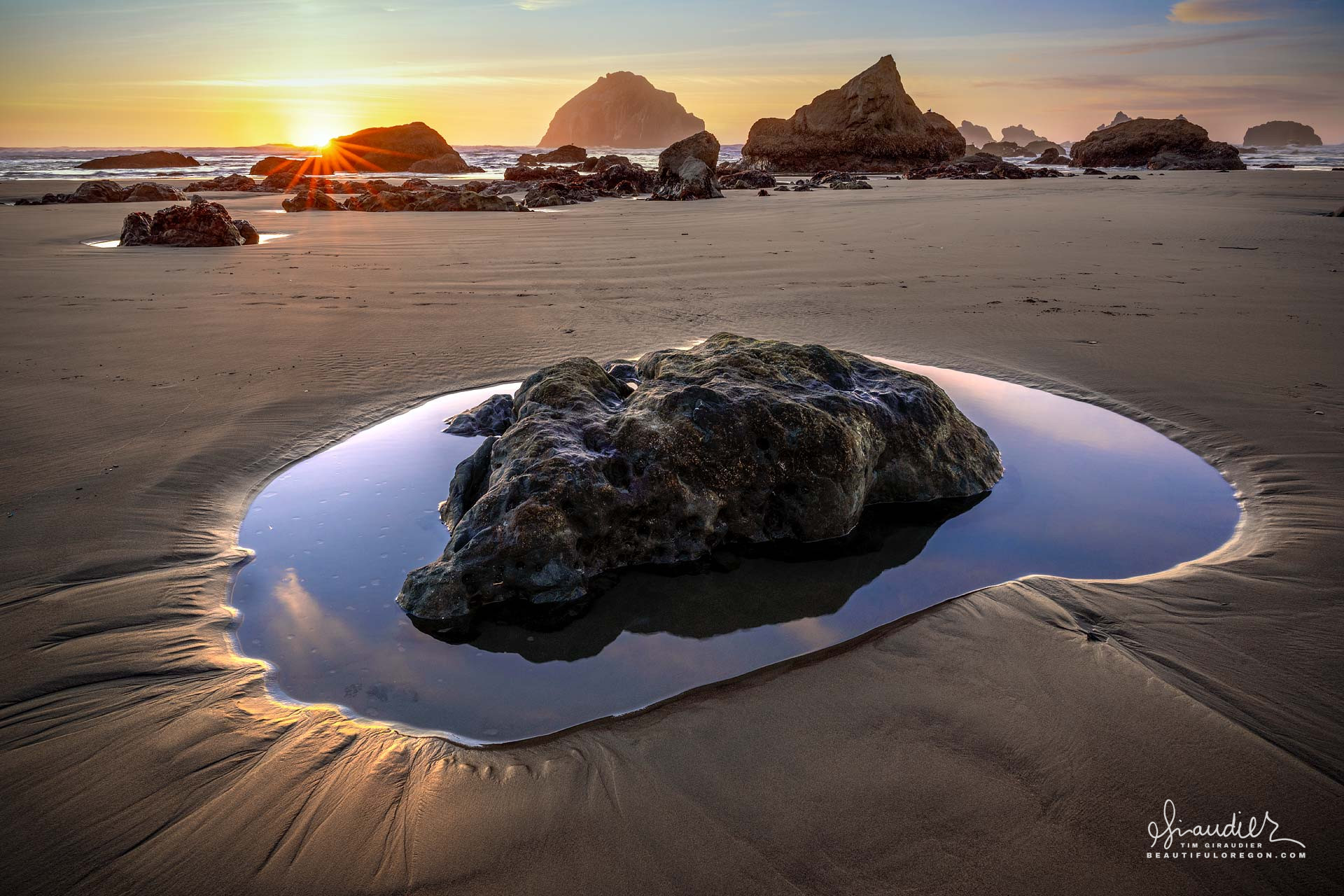
Bandon Beach Oregon Coast Sunset
$ 49.50
• Shipping: Immediately available 2 pcs
• Pickup: Immediately from store in Kaarina, Finland
• Pickup: Immediately from store in Kaarina, Finland
The History of Bandon Beach: A Cultural and Geologic Chronicle of Oregon’s South Coast Bandon Beach, located along Oregon’s southern coast near the mouth of the Coquille River, is renowned for its rugged sea stacks, expansive tide pools, and wind-sculpted sands. Its history is deeply rooted in the interactions between coastal geology, Indigenous land use, settler colonization, maritime commerce, and catastrophic fire. This layered history reflects both natural forces and human agency in shaping the modern landscape. Geologic Foundation: The foundation of Bandon Beach begins with the Otter Point Formation, a chaotic mélange of deeply deformed sedimentary and volcanic rocks accreted to the North American continent during the Late Jurassic to Early Cretaceous, roughly 145 to 160 million years ago. This formation, which includes sandstone, shale, ribbon chert, and basalt, was deposited in a deep ocean trench and later uplifted through subduction-related tectonics. Coastal erosion has since carved these ancient rocks into the dramatic sea stacks and headlands that now define Bandon Beach, with differential weathering preserving the more resistant lithologies as iconic offshore monoliths like Face Rock and Table Rock. Human Settlement: For millennia prior to European contact, the Bandon area was home to the Coquille people, who lived in villages along the river and coast. Their seasonal economy relied on salmon, shellfish, roots, berries, and the abundant resources of the tide flats and estuary. Archaeological evidence, including shell middens and cultural artifacts, points to long-term habitation, trade, and cultural development. The beach and surrounding lands held deep spiritual significance, with local oral histories incorporating place-based legends—such as the Face Rock story, which reflects themes of transformation and moral instruction tied to the visible sea stack formations. In the 1850s, white settlers arrived, and following the 1855 Coast Treaty and the forced removal of Indigenous people to the Siletz and Grand Ronde Reservations, the Coquille homeland was opened to colonization. The modern town of Bandon was formally established in 1873 by George Bennett, an Irish immigrant who named the town after his hometown of Bandon, County Cork. Early economic activity centered around timber, dairy farming, cranberry cultivation (introduced in the 1880s), and maritime trade through the Coquille River harbor. Shipping lumber and agricultural products was vital, and a series of jetties and the Coquille River Lighthouse (built in 1896) were constructed to facilitate navigation and commerce. The Fire of 1936: A defining event in Bandon’s modern history was the catastrophic fire of September 1936, which destroyed much of the town. The fire was fueled by a combination of strong winds and highly flammable gorse, a spiny, non-native shrub introduced by George Bennett. Once ignited, the gorse acted as an accelerant, and the firestorm rapidly consumed homes, businesses, and infrastructure. More than 250 buildings were destroyed, and eleven people died. The town was eventually rebuilt, but the fire left a permanent mark on Bandon’s identity, with gorse management becoming a continuing priority. In the postwar era, Bandon Beach became a hub for tourism, drawing visitors to its natural beauty, sea stacks, and beachcombing opportunities. The creation of Oregon State Parks along the coast, combined with the 1967 Oregon Beach Bill, which guaranteed public access to all beaches, solidified Bandon Beach as a beloved public resource. The surrounding area also supports protected habitats for nesting seabirds and marine mammals, with increasing efforts in the 21st century focused on dune restoration and habitat preservation. Bandon, Curry County, Oregon South Coast, Sea Stacks, Sunset, Tidepool
Fast and helpful service. Quality products. Highly recommended
Customers who bought this were also interested in...
You may also like…
Products are located in our own storehouse
In Kaarina, Finland.
Fast shipping
Orders are shipped out within 24 hours of us receiving the order.
Purchase online or offline
You can also pickup your order at our store.
Flexible payments
We accept Credit Cards & Online Banks etc.